LLMs Are Now on deAPI: 13 Chat Models on the Key You Already Have
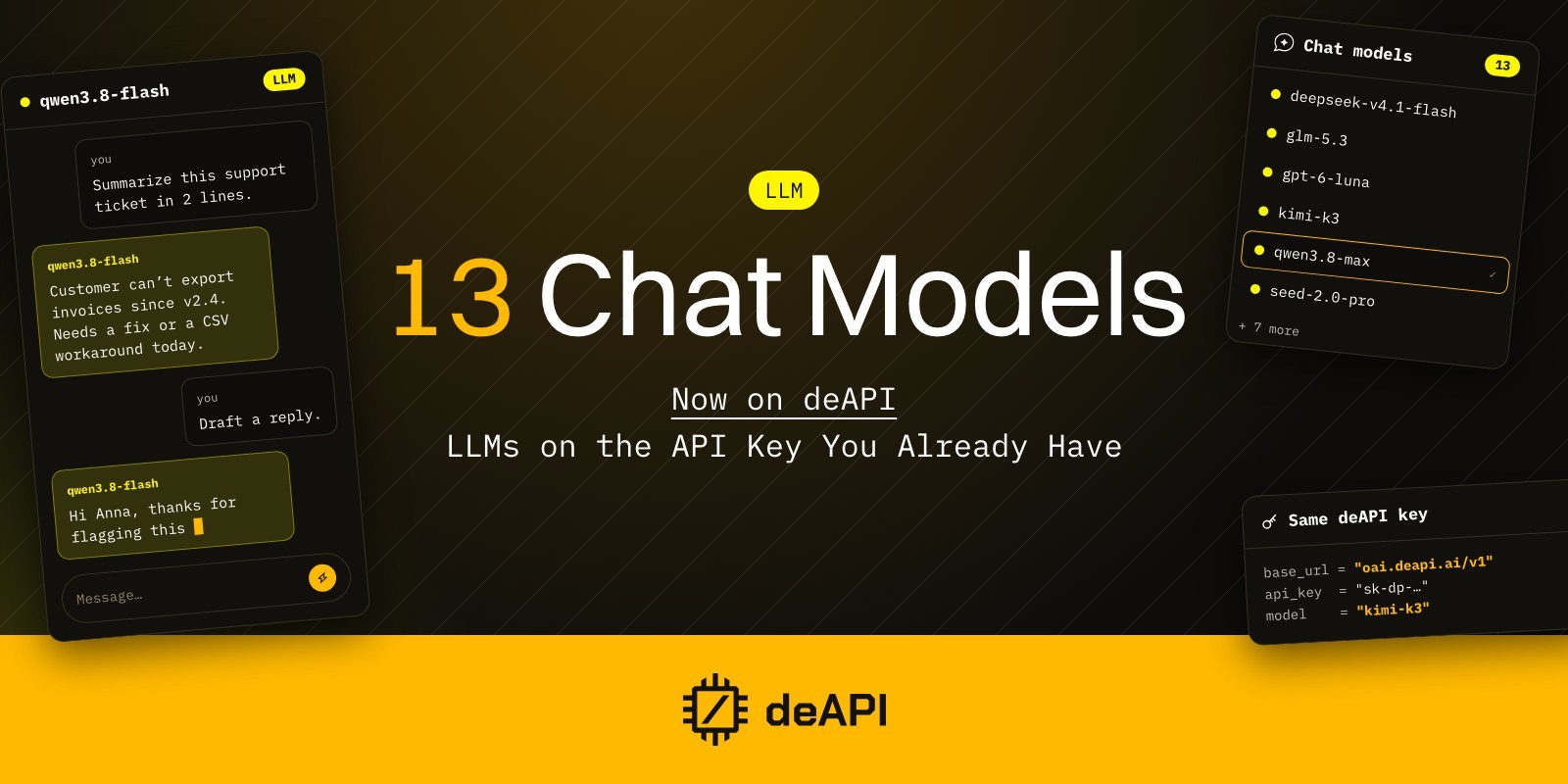
deAPI now serves 13 chat models, including DeepSeek, Qwen, GLM, Kimi and Seed. They run on the OpenAI-compatible endpoint at https://oai.deapi.ai/v1 and use the same API key and prepaid balance as image, video, speech and transcription.
Until now, a pipeline that transcribed a podcast on deAPI had to send the transcript to another provider for the summary, with its own API key and its own invoice. That step can now stay on the same account.
What you can build with it
Transcribe a call or a stream with Whisper Large V3 CT2, then ask a model for a summary with chapters. Eight of the models take a million tokens of context, so a transcript several hours long fits in one request.
For documents, OCR turns a photo of an invoice into Markdown, and a model with a JSON schema maps it to fields such as the invoice number and the total, which your code can validate and store.
Platforms that pass user prompts to an image or video model can screen each request first. The prompt and the reference image go to a vision model together with your policy, and an unsafe request is rejected before any generation credits are spent.
With tool calling, the model can also choose the next step. Describe deAPI endpoints as tools, and it answers with a call such as text_to_image with a prompt and a size, which your code then runs.
The models
Eleven of the 13 read images as well as text. glm-5.3 and hy3 take text only. Every model supports streaming and tool calling, and you can set reasoning_effort on all of them.
| Model | Input | Context (tokens) | Input / 1M tokens | Output / 1M tokens |
|---|---|---|---|---|
| deepseek-v4.1-flash | text, image | 1,000,000 | $0.315 | $1.26 |
| deepseek-v4.1-flash:economy | text, image | 1,048,576 | $0.252 | $1.008 |
| glm-5.3 | text | 1,000,000 | $1.47 | $4.62 |
| glm-5.3-flash | text, image | 1,048,576 | $0.1575 | $0.525 |
| gpt-6-luna | text, image | 1,050,000 | $0.105 | $0.525 |
| hy3 | text | 262,144 | $0.1386 | $0.5544 |
| kimi-k3 | text, image | 1,000,000 | $3.15 | $15.75 |
| qwen3.8-flash | text, image | 1,000,000 | $0.1575 | $0.4935 |
| qwen3.8-max | text, image | 1,000,000 | $2.10 | $6.30 |
| seed-2.0-lite | text, image | 262,144 | $0.2625 | $2.10 |
| seed-2.0-mini | text, image | 262,144 | $0.105 | $0.42 |
| seed-2.0-pro | text, image | 262,144 | $0.525 | $3.15 |
| seed-2.1-turbo | text, image | 262,144 | $0.525 | $2.625 |
Prices are in USD, read on November 26, 2026. Reasoning tokens are billed as output. deepseek-v4.1-flash:economy is the same model as deepseek-v4.1-flash at a 20% lower price.
Use cases and a full moderation example are on the LLM API page.
Your first request
If your code already uses the OpenAI SDK, point it at our base URL with your deAPI key and pick a model. Our OpenAI SDK guide covers the rest of the setup. The request below turns a short podcast transcript into show notes with a fixed JSON shape:
import os
from openai import OpenAI

client = OpenAI(base_url="<https://oai.deapi.ai/v1>", api_key=os.environ["DEAPI_API_KEY"])

transcript = (
    "[00:00] Welcome back. Today we are talking about running a small bakery. "
    "[02:10] The hardest part is the 4 AM start, every single day. "
    "[05:40] We switched to a smaller menu last year and sales went up 20 percent. "
    "[08:15] My advice: write down what sells out first and bake more of it."
)

schema = {
    "type": "object",
    "additionalProperties": False,
    "required": ["title", "chapters"],
    "properties": {
        "title": {"type": "string"},
        "chapters": {
            "type": "array",
            "items": {
                "type": "object",
                "additionalProperties": False,
                "required": ["time", "label"],
                "properties": {"time": {"type": "string"}, "label": {"type": "string"}},
            },
        },
    },
}

r = client.chat.completions.create(
    model="qwen3.8-flash",
    reasoning_effort="low",
    max_tokens=400,
    messages=[
        {"role": "system", "content": "You turn podcast transcripts into show notes. Return JSON only."},
        {"role": "user", "content": f"Transcript: {transcript}"},
    ],
    response_format={"type": "json_schema",
                     "json_schema": {"name": "show_notes", "strict": True, "schema": schema}},
)

print(r.choices[0].message.content)
print(r.usage)  # token counts and cost in USD
The model returned:
{
  "title": "Running a Small Bakery",
  "chapters": [
    { "time": "00:00", "label": "Introduction" },
    { "time": "02:10", "label": "The Hardest Part: Early Mornings" },
    { "time": "05:40", "label": "Smaller Menu, Bigger Sales" },
    { "time": "08:15", "label": "Key Advice" }
  ]
}
The call used 145 input tokens and 245 output tokens, 100 of which were reasoning, and cost $0.00014375. The same amount comes back in usage.cost and in the X-DeAPI-Cost response header, so you can log the cost of every call without a separate price lookup.
Limits
The models accept text and images. PDFs and audio files are rejected, so run a PDF page through OCR or a recording through transcription first and pass the text on.
glm-5.3 accepts only response_format: json_object. When you use it, list the keys you want in the prompt. The full parameter list is in the docs.
Run the text step on the same key
If your app already sends transcription or image jobs to deAPI, the step that writes the summary or fills in the JSON can run on that key too. Point your OpenAI client at oai.deapi.ai/v1 and pick a model from the table.