AI App Development Made Easy: 4 Reasons to Build on deAPI
The part of shipping an app that used to need a hired team now takes an afternoon in Rork, Lovable or bolt. You describe what you want and you get a working build, without the months you would otherwise have spent learning Swift.
The builder writes your client. Every decision on the other side of the network call is still yours, and the builder will make those decisions badly by default. Ask one to add image generation and it will put your API key in the client, because that is the shortest path to something that works on screen.
Four of those decisions come up in every AI app. Here is how each one goes on deAPI.
1. The API surface is small enough for a model to hold
Every media job on deAPI runs through the same three moves. You POST a request, you get back a request_id, and you collect the result when it is ready.
POST /api/v2/images/generations
{ "data": { "request_id": "123e4567-..." } }
Collection has three modes. Give us a webhook_url and the finished job arrives at your server as an HTTP POST, with HMAC signatures and retries backing off over roughly 24 hours. Subscribe over WebSocket and you get progress percentages and live previews mid-generation. Or poll /api/v2/jobs/{id} and read the status yourself.
That shape holds across images, video, music, speech, transcription and embeddings. Learn it for one endpoint and you have learned it for the platform, which matters more than usual when a language model is writing your integration. A small surface leaves less room to invent an endpoint that does not exist.
Two things help further. Point the official OpenAI SDK at https://oai.deapi.ai/v1, change base_url and api_key, and your builder generates code against a library it already knows cold. And https://deapi.ai/llms.txt is a structured index of the whole reference, written to be pasted into an AI tool rather than read by a person.
Which makes the integration step a key and a link to that file.
2. Your key stays on a server you own
An .ipa and an .apk are archives. Anyone can download yours from the store and unpack it, and mobile reverse engineering has beginner tutorials on YouTube. Electron is worse, since app.asar comes apart with a single npx command and hands over your JavaScript in readable form. Whatever credential you ship, you have published.
So the key lives behind a small service of your own: it holds the secret, checks a few numbers, forwards the request and hands back a job id. Tell your builder to generate that alongside the app, because it will not occur to it on its own.
Rate limits are the first thing that server buys you. Ours are keyed to your account rather than to individual humans using your app, and a Basic account gets 3 requests per minute and 100 per day on image generation, with any Stripe payment moving you to 300 RPM and no daily cap. “Ten images per user per day” is a rule only your own server can enforce, and it is also where you notice that one device has asked for four thousand.
Music generation caps the prompt at 300 characters and the track between 10 and 300 seconds. Checking that in your layer costs a millisecond, while finding out after the round trip costs a user a confusing error.
Then there is the release cadence. Every model swap inside a shipped app means a new build and a review queue, and on your server it is live the moment you deploy. A desktop app with an auto-updater has it easier, but you still do not want your model choice tied to your release schedule, and mobile leaves you no choice at all. New open-source models land faster than anyone ships app updates.
3. Both stores ask about privacy, and you have real answers
App Store Privacy Nutrition Labels and Google Play Data safety both ask, in a structured form, whether user data goes to a third party and whether it travels encrypted. You are declaring it either way, and the declaration is public.
Our documented behaviour gives you specifics. HTTPS is enforced at every stage of the round trip. On the machine that runs your job, the payload lives in RAM for the duration and nothing is written to disk or exposed through any interface. Our coordination layer sees the metadata it needs to route work and keeps no long-term store of payload data.
There are integrity controls under that. Request hashing prevents a node from returning a result it did not compute. The worker software verifies checksums on its own binaries and models before executing anything, and the execution environment is isolated against injection. For sensitive workloads, a job can be computed independently by two nodes and cross-checked, at double the compute cost.
None of this is a legal opinion and your privacy policy is still yours to write. It does mean that when the form asks where the audio goes, you fill the box with a documented answer.
4. Prototyping without a meter running
Every endpoint has a /price sibling that returns a quote before you generate anything. The call costs nothing, and on native models it comes back with is_estimated: false, so you are reading an exact figure rather than a range.
Priced this morning, a two-minute track on ACE-Step 1.5 Turbo at the model’s fixed eight steps came back at $0.0014311. FLUX.1 schnell quotes $0.00267734 for a 1024×1024 image at four steps, and Z-Image Turbo asks $0.00960865 for the same size at eight.
New accounts start with $5 of credit, which is roughly 3,490 two-minute tracks or 1,860 FLUX images before you have paid anything. Numbers that size take a decision off your plate. You get to find out whether the idea works by building it, rather than by reasoning about whether it deserves the compute.
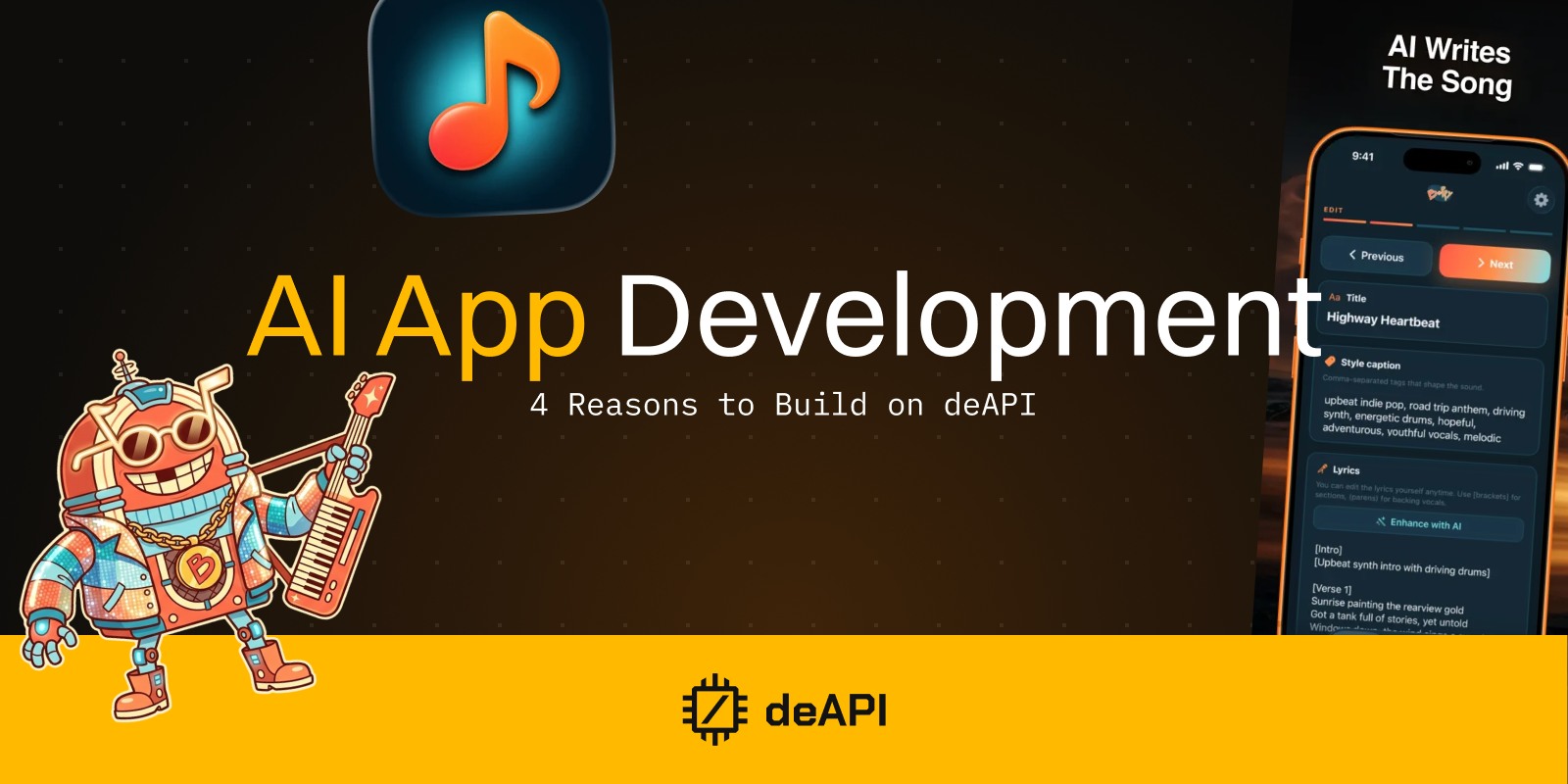
Boppy is what that looks like once it ships. It is an AI music generator, in the App Store since June, that turns a sentence into finished audio with lyrics and vocals in about a minute. The download weighs 10.8 MB, which is several orders of magnitude short of a music model, so nothing generates on the phone. Its bundle identifier reads app.rork.hnw5vsr86axbo49mv400j, which means it came out of Rork rather than out of Xcode. Its client calls /api on Boppy’s own origin, and searching the shipped bundle for our API turns up a link in the footer and nothing else.
Get an API key and your $5 in credit, then hand your builder llms.txt and describe what you want.